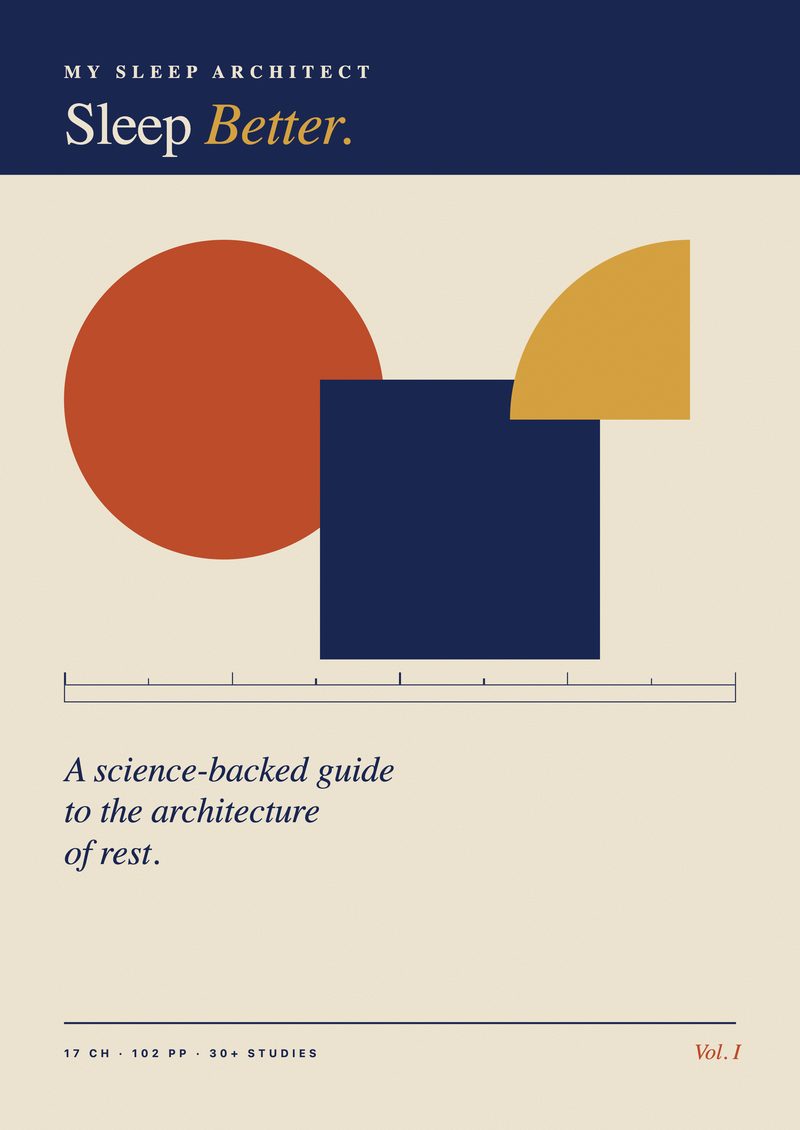
You've tried the apps. You've tried the melatonin. You've tried telling yourself to "just relax." This is the field manual that actually fixes your sleep — built on peer-reviewed research, written by someone who thinks you deserve to understand why things work, not just be told what to buy.
Get the Guide →102 pages of science you can use tonight • PDF + EPUB + MOBI • Instant delivery
The average adult spends 2 hours and 12 minutes awake in bed each night. That's 33 days per year lost to staring at the ceiling.
Sleep deprivation doesn't announce itself with sirens. It creeps in — foggy mornings, irritable afternoons, a body that seems to age faster than it should. The research is unambiguous about what's happening underneath.
People sleeping fewer than six hours had 4.2 times the risk of infection compared to seven-hour sleepers. (Prather et al., 2015)
The US alone loses over $411 billion per year in productivity due to insufficient sleep. That's 1.23 million working days.
Chronic short sleep in midlife is associated with a 30–33% increased risk of developing dementia later in life.
Most sleep supplements either don't work, work for the wrong reasons, or are dosed incorrectly. This book tells you which ones actually hold up.
Learn what circadian rhythms, chronotypes, and sleep architecture actually mean — and why most "sleep tips" ignore them entirely. Chapters 1–3 rewire how you think about sleep.
The bedroom audit. The light protocol. The wind-down routine. The supplement stack that works (and the ones burning your money). Chapters 4–10 are your implementation playbook.
Anxiety, racing thoughts, CBT-I, sleep disorders, tracking obsession, and when to see a professional. Chapters 11–17 deal with the things no listicle will tell you.
| Sleep Better | Other Sleep Books | |
|---|---|---|
| Sources | 31 peer-reviewed studies cited & linked | "Studies show..." (no citation) |
| Supplements | Ranked by evidence, dosed precisely, BS flagged | "Try magnesium!" |
| Tone | Witty, honest, respects your intelligence | Dry textbook or wellness fluff |
| Medications | Honest risk/benefit with landmark research | "Pills are bad" or silence |
| Mental Health | Full chapters on anxiety, CBT-I, and when to get help | Ignored or handwaved |
| Actionability | Tonight/This Week/This Month tier system | "Improve your sleep hygiene" |
| Sleep Tracking | When it helps, when to stop, and the orthosomnia trap | "Track your sleep!" |
"I've read Walker's Why We Sleep and Huberman's protocols. This is the first book that told me exactly what to do, in what order, and was honest about what doesn't work. I'm falling asleep 25 minutes faster."
"The supplement chapter saved me about $80/month. I was taking five things — turns out two of them were useless and one was counterproductive. Worth the price of the book ten times over."
"I didn't know CBT-I existed. My doctor never mentioned it. Chapter 12 changed the trajectory of my insomnia more than the sleeping pills I'd been prescribed for three years."
The average person spends $1,200+ per year on sleep products that don't work. This guide costs less than a single bottle of premium melatonin gummies.
If you implement the protocols in this book for 30 days and don't see measurable improvement in your sleep quality, send me an email describing what you tried. Full refund, no questions beyond that one. I wrote this book because the science works. If it doesn't work for you, I don't want your money.
It's written like a conversation with a well-read friend who happens to have access to PubMed. The science is rigorous — every claim is sourced — but the tone is warm, occasionally funny, and never condescending. You'll learn about your suprachiasmatic nucleus while laughing about supplement marketing.
Why We Sleep is an excellent primer on sleep science. This book starts where that one stops: it tells you exactly what to do, in what order, with specific protocols, dosages, and timelines. It also covers topics Walker doesn't, including supplements (ranked and dosed), prescription medications (honestly), sleep tracking pitfalls, and the full CBT-I protocol.
This book is not a replacement for medical treatment. Chapter 15 is specifically about red flags — sleep apnea, restless legs, narcolepsy, and parasomnias — and helps you understand when you need a doctor. The lifestyle and environmental chapters will still be useful alongside professional treatment, but please consult your healthcare provider.
You'll receive three formats: a beautifully formatted PDF (perfect for screens and printing), EPUB (for Apple Books, Kobo, and modern Kindle), and MOBI (for older Kindle devices). All are designed to be easy to read and navigate, with a full table of contents and cross-referenced chapters.
Chapter 16 is a cheat sheet organized into "Tonight," "This Week," and "This Month" tiers. You can implement the first tier in under two hours and feel the difference by tomorrow morning. The deeper chapters give you the understanding to sustain and build on those quick wins.
Every night you don't fix this costs you energy, health, and years. The science exists. The protocols work. The only missing piece is you deciding to use them.
Get Sleep Better Now →